August 21, 2026
Molly McCormick
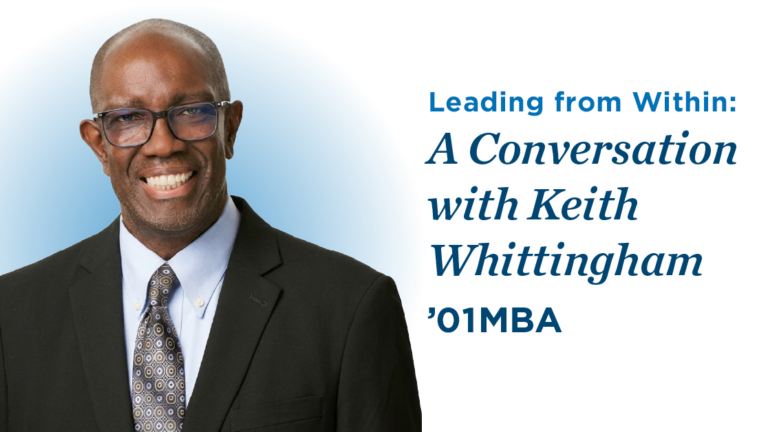
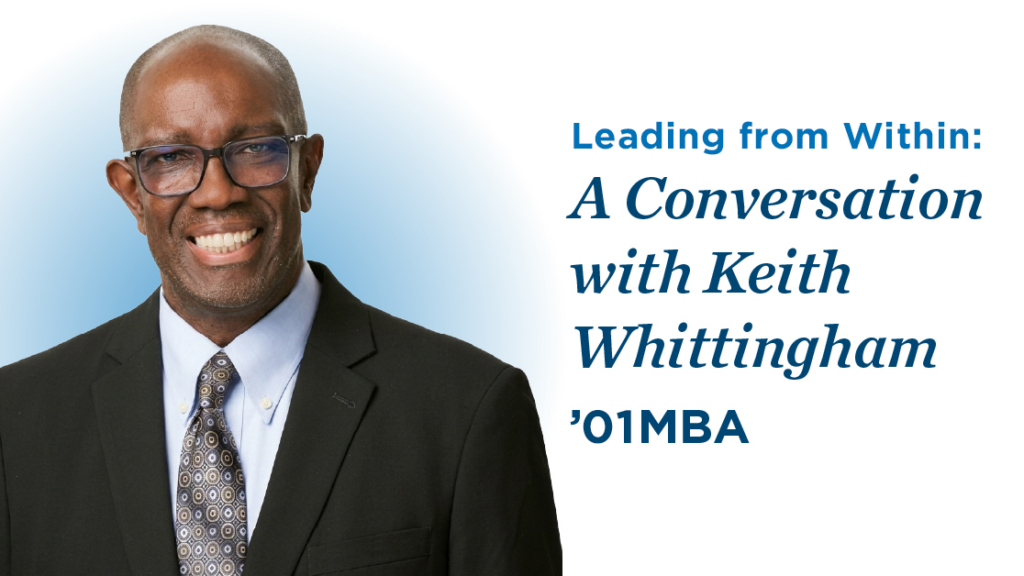
Leading from Within: A Conversation with Keith Whittingham, ’01MBA
What can we help you find?
Frequently searched
August 21, 2026
Molly McCormick
With a career spanning engineering, corporate leadership, academia, and entrepreneurship, Associate Professor and Crummer alumnus Keith Whittingham brings a unique perspective to the role business can play in creating positive change. From his work with Crummer students on international consulting and sustainability projects to his research on global societal impact, Dr. Whittingham has spent decades exploring the connection between business and purpose. After learning of Dr. Whittingham’s upcoming retirement, we sat down with him to learn more about his journey, his approach to leadership, and what he hopes he inspired in the next generation of business leaders.
1. You’ve had a career in engineering, business, academia, and entrepreneurship. What experiences have shaped you most as a leader?
In all of these arenas, two aspects of leadership have stood out to me: “leading from within” and “servant leadership”. I would say that most of my leadership has not been top-down leadership of a team but from a position among peers or even leading from behind. At times you have to step up and do or say the right things that are necessary in the moment, even if you aren’t the one in charge. That takes risk, but the right team culture can allow you to do that. Those can be defining moments. And for me, servant leadership has many aspects, but it fosters the kinds of teams where people can and do step up. The most effective leadership, in my view, includes creating space for everyone to be potential leaders, in their specific arena or whenever the need arises.
2. You’ve worked with Crummer students on international consulting and sustainability projects for more than 20 years. What have you learned from these experiences?
I’ve learned that we really prepare our students well for the real world. I’ve seen this repeatedly as our students have delivered incredible value to clients in global and domestic consulting projects. I saw it in a very pointed way during the five years in which we were engaged with the Nespresso Global MBA Sustainability Challenge. Crummer Teams made it to the finals four out of the five years of competition.
The last year was the most difficult case. One of the competition coordinators told me privately that a top-ranked school’s faculty advisor complained when their team did not advance, claiming the case was too hard and too complex. I was stunned at that reaction because this was a real-world case that Nespresso’s senior leaders were facing. Crummer students are prepared to take on the real complexity of the business world.
3. You believe business and entrepreneurship can help solve global challenges. Where do you see the biggest opportunities for businesses to make a positive impact today?
Bringing innovative solutions to scale is something that business and entrepreneurship are uniquely suited for. I would say the biggest opportunity for business to make a positive impact, in whatever sphere they operate, is for leaders to think strategically about the holistic and systemic nature of the world around them and the problems that they try to solve for. No problem exists in a vacuum, and therefore no solution can exist in a vacuum either. Leaders need to remember that. If we’re addressing broad societal challenges, another opportunity to consider is multi-sector collaboration. This means engaging with nonprofits, the civic sector, and governments, and viewing these groups not just as potentially adversarial stakeholders, but as co-creators of solutions.
4. Your teaching philosophy is “Inspire, Engage, Unleash.” What does that mean to you, and how can alumni apply it in their own careers?
I wrote these three words on a corner of the whiteboard in my office. One day a colleague came in and said, “Wow that’s a very concise teaching philosophy.” It was the first time I had ever thought of it as a teaching philosophy. Originally, I was really trying to capture the way I wanted to guide my sons, but it does capture the essence of my teaching philosophy as well.
1. Step one is to inspire, to help students understand the why and feel the why behind the situation.
2. Secondly, I teach through engaging. It’s not just a matter of telling or showing but really having the students engage with the material, engage with the problem, and with the various approaches to arriving at a solution.
3. Thirdly: Unleash. Turn the students loose on real problems. Whether it’s through case studies or consulting engagements, place them in the real world. Bring the abstract into the concrete.
In terms of applying it in one’s career, I suppose it could be an approach to guiding and mentoring teams and individuals, but it can even apply to oneself.
“Inspire”: Understanding the why behind the career choices and aspirations that we have can be very instructive.
“Engage”: Really showing up and doing the thing is essential. As Ralph Waldo Emerson said, “Do the thing, and you shall have the power.”
“Unleash”: Don’t be afraid to step out and bring who you are and what you know to new experiences.
Dr. Keith Whittingham will retire from Crummer faculty at the end of this academic year.
We use cookies to improve your experience on our site. By using our site, you consent to cookies.
Manage your cookie preferences below:
Essential cookies enable basic functions and are necessary for the proper function of the website.
Google Tag Manager simplifies the management of marketing tags on your website without code changes.
Statistics cookies collect information anonymously. This information helps us understand how visitors use our website.
Clarity is a web analytics service that tracks and reports website traffic.
Service URL: clarity.microsoft.com (opens in a new window)
Google Analytics is a powerful tool that tracks and analyzes website traffic for informed marketing decisions.
Service URL: policies.google.com (opens in a new window)
Marketing cookies are used to follow visitors to websites. The intention is to show ads that are relevant and engaging to the individual user.
HubSpot is an all-in-one marketing, sales, and customer service platform that streamlines business growth.
Service URL: legal.hubspot.com (opens in a new window)
You can find more information in our Cookie Policy and Privacy Policy.
Questions? Maddie can help anytime. Chat with her now, or open your text app to message her directly.
Chat with Maddie and she’ll help you get the brochure for this program. You can also download it directly below.