Leadership and Management Skills: What They Are and How to Develop Both

You can be highly organized, consistently hit your targets, and still feel stuck in your career.
That’s because progression isn’t just about doing more; it’s about contributing differently. As roles become more senior, the expectation shifts from executing tasks to setting direction, influencing others, and making decisions that shape outcomes.
This is where leadership and management skills come into play. Leadership is about vision, alignment, and navigating change. Management is about structure, execution, and delivering results. To move forward, you need both.
In this guide, we’ll break down how these skill sets differ, how they work together, and how you can start developing them to unlock new opportunities in your career.
Leadership vs. Management at a Glance
- Effective leadership is fundamentally about setting direction. It requires defining a clear vision, shaping long-term strategy, and ensuring everyone understands the organization’s goals. Leaders look ahead, inspiring new possibilities and driving the organization forward. They focus on the “what” and the “why,” ultimately steering the organization toward success.
- Management, conversely, focuses on execution. Managers translate high-level strategies into structured plans by organizing teams, allocating resources, and overseeing day-to-day operations. In essence, they handle the “how,” ensuring steady progress and consistent results.
Core Leadership Skills
Leaders are visionaries, always looking for ways to pursue and inspire growth. The following skills are critical to their success:
- Vision: Set a clear, inspiring direction for the future, helping people see what’s possible.
- Communication: Share the vision, goals, and strategies in ways that connect and motivate.
- Integrity: Build trust through honesty, consistency, and ethical behavior.
- Decision-Making: Make tough calls, weighing opportunities and risks while staying steady under pressure.
- Empathy: Build meaningful relationships and understand employees’ needs.
- Strategic thinking: Analyze complex situations to anticipate challenges and connect decisions to long-term business outcomes.
- Influence without authority: Don’t rely on formal power or direct reporting lines to gain buy-in and drive action across teams.
Core Management Skills
Managers focus on execution—getting things done efficiently and effectively. These skills are central to that role:
- Organization: Bring clarity and structure to tasks, creating processes that keep things moving smoothly.
- Communication: Share clear expectations, timely updates, and helpful feedback as needed.
- Problem-Solving: Troubleshoot issues, finding practical solutions to keep projects on track.
- Time Management: Prioritizing tasks and meeting deadlines efficiently.
- Delegation: Assign the right work to the right people, empowering them to deliver results.
- Performance management: Set clear expectations, track progress against goals, and provide feedback/coaching.
- Operational accountability: Take ownership of outcomes and ensure processes are followed/targets are met.
The Seven Core Differences Between Leadership and Management
Let’s discuss the leadership and management skills that top performers demonstrate through seven different areas. Here’s the TL, DR:
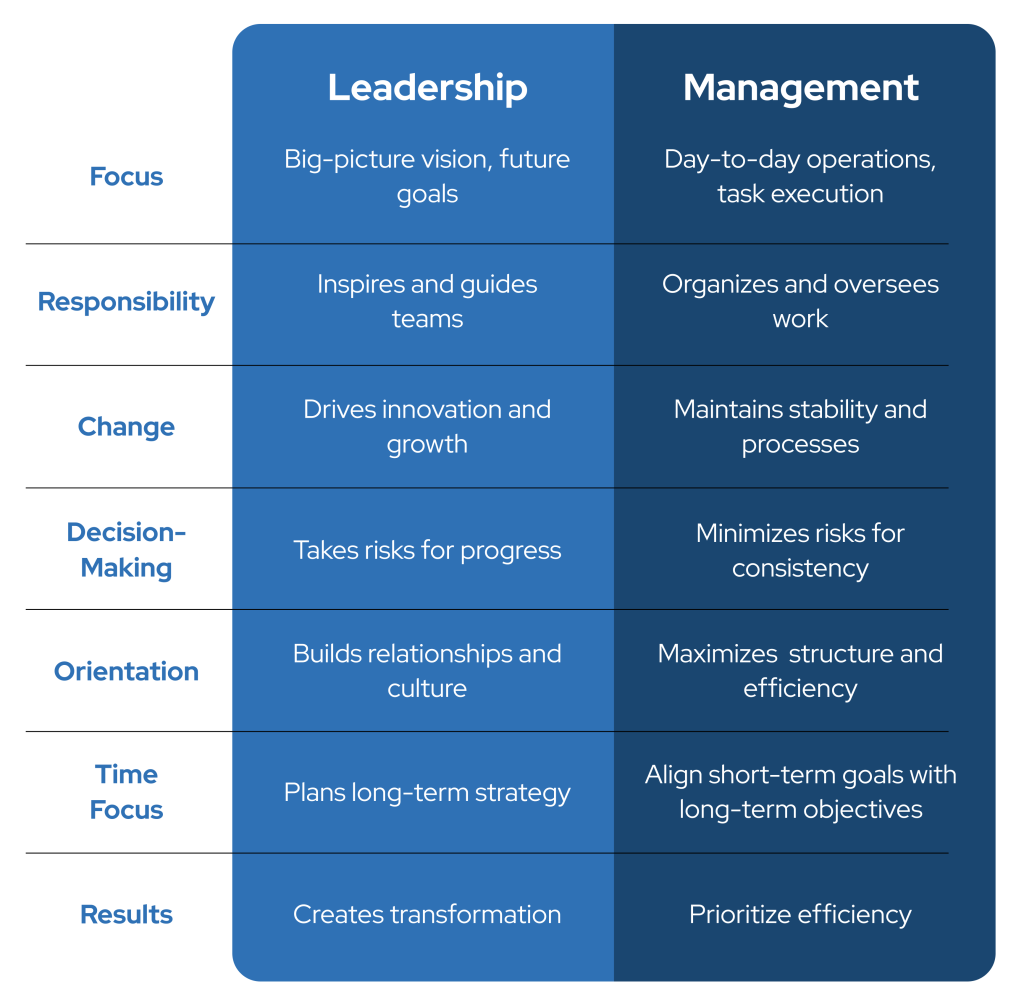
Now, let’s break down what these skills look like in practice and why they matter for career progression.
1. Role Focus
Leaders, like CEOs, take a big-picture approach—developing the organization’s strategic vision, identifying growth opportunities, and upholding company values. Their top priority is positioning the company for future success.
Managers, on the other hand, focus on the operational side. They manage workflows, assign responsibilities, and oversee timelines and resource allocation to ensure projects are completed on time and meet expectations. Their job is to get things done while making sure that internal operations align with the company’s overall strategy.
What this looks like in practice: A leader must identify where a business is headed next. A manager ensures current projects, teams, and processes run smoothly.
This matters for career progression because advancement requires you to shift from just completing tasks to shaping how your organization can grow or scale up.
2. Responsibility
Leaders define the organization’s purpose, setting a clear and compelling vision that inspires others across the company.
Managers bridge the gap between vision and execution. They translate big ideas into actionable plans—organizing teams, setting smaller goals, tracking progress, and addressing challenges as necessary.
What this looks like in practice: Leaders leverage research, creative thinking, and clear strategic communication to develop big-picture plans. Management skills include attention to detail and emotional intelligence.
This matters for career progression because gaining skills in each area ensures you feel prepared to advance to a management position and to prepare for even higher leadership roles.
3. Change
Skills in both leadership and management are key during moments of business transition. Leaders look for opportunities to move the company forward, pushing boundaries and encouraging creativity to keep the business competitive.
In contrast, managers focus on continuity. Their job is to develop and maintain processes that keep operations running smoothly and projects on track.
What this looks like in practice: While leaders focus on future possibilities and pursue growth, managers remain committed to maintaining consistency, even as the company changes.
This matters for career progression because fast-growing organizations promote professionals who can lead change (not just maintain existing systems).
4. Decision-Making
Decision-making is important to both leadership and management. Leaders are usually in a position to take bold risks, implement new ideas, and be agile in the face of uncertainty. Managers make decisions based on risk mitigation. They take a cautious approach to decision-making, ensuring day-to-day operations aren’t impacted.
What this looks like in practice: Leaders make high-stakes decisions, sometimes without complete information. Managers reduce uncertainty by relying on data and processes.
This matters for career progression because if you want to step into a senior role, you need to become comfortable with ambiguity and be accountable for major decisions that impact the company.
5. Orientation
Leaders are oriented towards people, building relationships, and inspiring teams with their vision. Managers also manage people, but must be oriented toward process—creating systems and structures to maximize efficiency, so that tasks are completed.
What this looks like in practice: Leaders invest time in alignment and culture, guiding organizational change. Managers are oriented towards keeping teams productive through workflows and systems.
This matters for career progression because: Advancing in your career requires the ability to influence, develop, and align people, as well as manage processes and outputs.
6. Future Focus
Leaders focus on long-term goals and strategies, anticipating what the company might look like years down the line, including preparing for opportunities and challenges, growth, and sustainability. Managers are more typically focused on shorter-term goals, though their efficiency and alignment lay the foundation for long-term success.
What this looks like in practice: Leaders plan for future growth and market positioning. Managers focus on hitting short-term goals and immediate performance.
This matters for career progression because: Advancement requires thinking beyond just short-term goals and demonstrating ownership of long-term business outcomes.
7. Results
The result leaders aim for is transformation. They seek opportunities to take the company to new heights. Managers’ successful result is efficiency. Over time, their refinement of processes and systems results in productivity, supporting larger transformations within the company.
What this looks like in practice: Leaders drive major change for business impact, while managers optimize existing systems and processes.
This matters for career progression because: Organizations entrust leadership roles to professionals who can create meaningful, measurable impact.
You Need Both Skillsets
Top professionals must master both leadership and management simultaneously. In practice, they are two complementary sides of the same coin, operating together to create sustainable competitive advantage. Effective leaders need managerial skills to execute their vision, and the best managers inspire and influence like true leaders. Operating successfully in this gray area—leveraging both sets of skills—is what distinguishes high-potential talent.
For senior career progression, a demonstrated capability to both lead (inspire, influence, and set direction) and manage (plan, organize, and execute reliably) is not optional; it is the prerequisite for success.
How to Develop Leadership and Management Skills
This guide has defined the essential differences between leadership and management, highlighting why you need to develop both skillsets to advance your career. Now, let’s look at practical steps you can take to build and refine these crucial capabilities, turning knowledge into action and impact.
Move Beyond Task Execution
Volunteer for opportunities to collaborate across departments to gain exposure to different organizational functions. Develop a holistic view of your organization by understanding how finance, operational execution, and strategy connect. Pay attention to how financial decisions, operations, and strategic priorities work together to influence overall performance.
Build Cross-Functional Perspective
Effective leadership requires sound judgment under pressure, especially when not all data is available. You must build confidence in making informed decisions using limited data and experience. Successful leaders learn to act with incomplete information. This involves practicing assessing risks, weighing trade-offs, and taking decisive action, even when outcomes are uncertain.
Practice Decision-Making Under Uncertainty
Leadership requires sound judgment under pressure, building confidence in making informed decisions even with limited data and experience. You must be able to take decisive action even when outcomes are uncertain; practice assessing risks, weighing trade-offs, and acting with incomplete information.
Develop Influence, Not Just Authority
Leading without a title means you can guide your peers and contribute ideas effectively, even when you don’t have formal authority or direct control over a decision. To build trust and alignment, you should work to influence others through clear communication and by understanding their perspectives. This process will help everyone align around shared goals.
Learn in Simulated High-Stakes Environments
True growth comes from seeking out challenging situations where decisions carry consequences and leadership skills are tested. This is how you will grow as a leader. Gain hands-on experience in a safe space: Structured environments like Crummer’s MBA programs simulate high-stakes decision-making. This allows you to build leadership judgment through real-world business challenges and collaboration.
Practical Examples in Leadership and Management
When applied effectively, strong leadership sets the organizational vision and inspires commitment, while robust management translates that vision into achievable goals, ensuring efficient execution and reliable results day after day. This seamless combination of “why” and “how” is the key to both professional advancement and business success.

A classic example is Apple: Steve Jobs and Tim Cook represent the perfect balance of leadership and management. Jobs, with his bold vision and relentless drive for innovation, changed the tech world with groundbreaking products like the iPhone, iPad, and MacBook.
Meanwhile, Cook, as CEO, brought structure and efficiency to Apple’s operations. His knack for refining processes, optimizing the supply chain, and scaling production turned Apple into the global powerhouse it is today. While Jobs inspired the future, Cook made it a reality.
How Rollins MBA Helps You Develop Leadership and Management Skills
A structured learning environment, such as an MBA program, accelerates the development of both skillsets by offering a safe space to practice high-stakes decision-making and immediate feedback, turning theoretical knowledge into proven leadership judgment and managerial expertise.
At Crummer Graduate School of Business, our MBA programs help students build the necessary skills for any management or leadership role:
Accelerated Management Program
Our 3+2 Accelerated Management degree program enables current undergraduate students to gain the technical expertise of an MBA, with a focus on leadership development, strategic thinking, and foundational business skills.
Graduate and Executive Programs
For professionals looking to advance their careers, we offer flexible full-time, hybrid, and executive MBA degree programs. Whether you want to grow as a leader, deepen your expertise in a specific field, or pursue advanced strategic experience, Rollins MBA supports your unique goals throughout every stage of your career.
Read more about the Return on Investment (ROI) of an MBA program.
It’s Time to Develop Leadership and Management Skills with Rollins MBA
If you are asking what leadership management skills are and how to develop them to advance your career, remember that relying on execution alone is insufficient. Advancing requires the ability to think strategically, make decisions under pressure, and influence outcomes across teams. Organizations promote professionals who can use influence to reach clear strategic outcomes.
A structured learning environment can accelerate that development by giving you the opportunity to apply these skills in real-world scenarios. At Crummer Graduate School of Business, our programs are designed to help you build the judgment, confidence, and real-world experience it takes to lead effectively. If you’re ready to move beyond managing tasks and start shaping outcomes, Crummer can help you take the next step.
Ready to get started? Learn how you can accelerate your leadership trajectory with a Crummer MBA.
Frequently Asked Questions
What are leadership and management skills?
Leadership skills generally focus on vision and influence. Management skills focus on planning, operational execution, and delivering results that are both consistent and measurable
Can you be both a leader and a manager?
To be effective, professionals must combine both leadership and management skills. This enables them to set direction while ensuring teams execute tasks efficiently.
Which is more important for career growth: leadership or management skills?
Both leadership and management skills matter for career growth. Leadership ability unlocks advancement opportunities, while management demonstrates you can deliver on your vision.