April 6, 2026
Molly McCormick
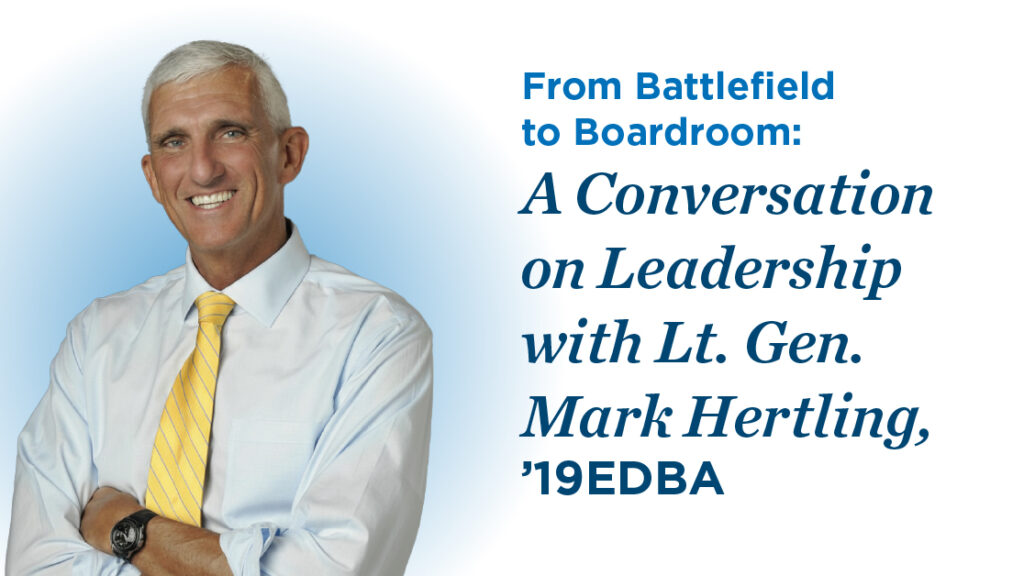
From Battlefield to Boardroom: A Conversation on Leadership with Lt. General Mark Hertling, ’19EDBA
1. You’ve had a very impressive career! How would you describe the journey that brought you from senior military command to the Crummer classroom?
I’ve had a very blessed life, and the move from a long military career, to serving in healthcare, to working with a major media organization, to the Crummer classroom has been, I believe, a continuation of service. After nearly four decades in the Army—commanding at different levels, leading in multiple combat deployments, and engaging with multinational organizations in Europe and the Middle East—I came to believe that the most enduring thing leaders can do is help develop others and share their scar tissue to help others from gaining their own. I’ve found a true passion for teaching and engaging with young men and women who want to be leaders.
At Crummer, I found a community that values ethical leadership, global awareness, and practical experience—principles that align closely with what I learned in uniform. Teaching here feels less like a fourth career and more like a new mission.
2. You earned your executive doctorate in business administration at Crummer and now serve as professor of practice in leadership. How did it feel to return to academia after decades of military service, this time as both a student and later as a faculty member?
The Army gave me many opportunities to return to academia, as that’s part of the leader development model we use. But pursuing a doctorate at Crummer after receiving multiple master’s degrees at other civilian and military institutions was both humbling, invigorating, and challenging. As a doctoral student in a very talented, diverse cohort, I had the opportunity to engage with a wide range of personalities and industries, which in itself was a terrific experience.
Transitioning later to a faculty position after Dean Menon asked me to design a new leadership approach to the curriculum was a unique opportunity, and it’s been incredibly fun. Every new course we introduced over the last two years has been a challenge, and I’ve been accepted by the more experienced faculty. But having recently sat where my students are now sitting, I understand their aspirations, and that makes teaching in the same building especially meaningful.
3. Is there a particular moment during your time as a Crummer student and professor that stands out as especially meaningful?
[laughs] There absolutely was! During our cocktail reception before the course started in 2016, I asked a second-year doctoral student to share what she had learned at Crummer to help me navigate the program. Her name was Rhonda Bartlett, who became a dear friend during the program, and she told me: “You’re a guy with a lot of world experience, and you’ve led large organizations…but at Crummer, you’re going to learn just how much you don’t know.” Boy, was she ever right.
And, since beginning my teaching career, a particularly meaningful moment came during a cohort discussion on leadership failures. I’ve had some failures in my various careers, but in that discussion, it became clear that the root causes—loss of trust, poor communication, ethical lapses, the loss of humility—were universal across industries.
That realization reinforces a powerful lesson: leadership principles transcend industries. Whether on a battlefield, in a hospital, or in any other organization, trust and character remain the foundation of effective leadership.
4. In your view, what distinguishes a Crummer leader from leaders developed elsewhere?
Crummer leaders are distinguished by their integration of character, adherence to business ethics and personal values, and competence in their field. The program emphasizes analytical rigor and strategic thinking while also stressing ethical responsibility and the human dimension of leadership. And most importantly, I believe the emphasis in every classroom is on the pragmatic application of business practices. It isn’t just studying for the sake of studying; it’s about applying the learning to help organizations grow and be the best.
Students examine how their character and values shape decisions and how their presence affects others—critical in a world where trust can be lost quickly. Crummer also fosters a global perspective, preparing leaders to navigate cultural differences and complex stakeholder environments with confidence and humility.
5. What leadership habits do you believe are most critical for both students and alumni navigating today’s complex global environment?
Three habits are essential.
First, disciplined curiosity—seeking diverse perspectives and challenging assumptions. Learning and growing every day.
Second, clear and precise communication. In our era of rapid information flow and mis-, dis-, and mal-information, leaders must ensure their messages are understood as intended.
Third, building and sustaining trust through character, adherence to values, and competence. These habits are daily practices that define leadership over time.
6. You’re taking students to Gettysburg this month. Can you share with us what inspired that experience, and what lessons you hope students will gain from studying the battlefield firsthand?
I’m exceedingly excited about leading this elective, which we designed this year. The “staff ride,” as we call it in the military, provides leadership lessons placed in context, and it allows for a comparison between an event that had a unique outcome— a battle in the Civil War— with everyday leadership lessons that those in business deal with on a daily basis. We will see how we can learn from history, and learn how important things like clear communication, adapting strategies, influencing the boss, taking the initiative, toxic leadership, crisis management, and a bevy of other topics teach us universal lessons. I’ve been on hundreds of staff rides, all over the world, and every time the participants come away with a unique understanding of leadership issues, no matter the “business.”
Gettysburg, particularly, offers timeless lessons in leadership and organizational behavior—how leaders operate under uncertainty, how communication failures alter outcomes, and how ego can undermine sound plans. It also highlights courage, initiative, and moral leadership.
My hope is that students gain an experiential, much deeper understanding that leadership is human, consequential, and shaped by moments of choice.