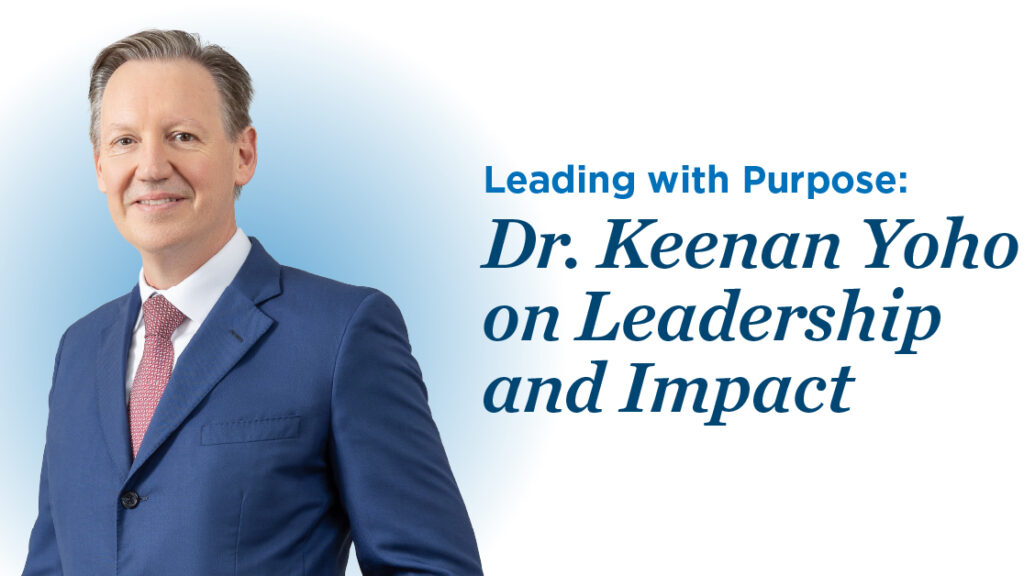
Known for his direct approach and emphasis on real-world discipline, Dr. Keenan Yoho encourages his students and Crummer alumni alike to seek out mentorship, embrace risk, and lead from the front, especially when it matters most.
In this interview, Dr. Yoho reflects on leadership, his experiences, and how Crummer alumni can lead in a global business environment.
1. Your career spans advising the U.S. military, working with global companies, and teaching at Crummer. Looking back, what experiences or moments shaped the way you approach leadership today?
I had good mentors and there were some good leaders along the way. Good mentors and colleagues can make up for poor leaders, but you cannot stay anchored to poor leadership for long. I chose my mentors and never referred to them as such. I found someone — usually much more senior — who had deep knowledge and experience and I would show up on their door and ask them if they would be willing to have coffee or lunch with me. This led to life-long friendships little by little. Behavior matters. If you cannot show up on time and look the part of the role you aspire to (not the role you are in), then you are missing the first step to advancing professionally. I tell students all the time: I can teach you, but I cannot save you from your own bad habits. Knowledge without the behavioral characteristics that accompany professionalism will not put you in a leadership role.
2. What insights do you hope Crummer students and alumni take from your journey?
Take intellectual risks as a graduate student and ignore the grades and other noise that have nothing to do with learning the subject matter. Use graduate school as an opportunity to break old habits and form new ones. This is easy to say and hard to do. If you are doing the minimum, then you are selling yourself short. If you really want to learn deeply, then the assignments you are given are the starting line not the finish line. No one will tell you that “you are fired” prior to simply ignoring you and cutting you off from everything that is relevant. If someone is correcting you or providing you with constructive guidance or constructive criticism, it means they are invested in you and have not given up on you yet. When they ignore you, then that is the indicator that they have moved on and that you no longer matter.
3. Many Crummer alumni lead organizations that are balancing growth with change. From your experience, what’s one principle or habit that helps leaders successfully navigate transformation?
I have never seen a transformation succeed where the leader was not present all the time and lived where the challenge was. Say what you will about Elon Musk: When the M3 factory was in trouble, he slept there until it was fixed. So, if you want to transform an organization, then there is nothing more powerful than the physical manifestation of your commitment. If you are not there, you are not there. The rest is easy to say but more difficult to do. Vision and urgency first, strategy second.
If there is no existential threat, then it is difficult to get organizations to transform. You have to build a transformation habit and the ability to change quickly into the organizational habits. This can take years and decades. Most organizations begin transformation reactively (not proactively). If they survive, they have to build a habit of changing to survive long-term. I used to teach a course called “Business Transformation through Operations” but it has not been offered in a while. This course took a lot of what I have learned through experience in transforming global organizations. Perhaps it will run again in the future. Transformation is one of the biggest topics that comes up when I speak with business leaders.
4. In 2025, you took a group of Crummer students to Milan, Italy, for an international immersion experience. What moment stood out to you the most about that trip? In your view, how are students approaching global business challenges?
The Milan Global Immersion had many moments that stood out — almost every moment — because it was built around every minute we were there. And I integrated some very important relationships — friends and professionals — who I have known for several years. There were a lot of “easter eggs” built into that trip that the students discovered when we were there, and sometimes realized afterward. I designed it for intensity and a long half-life. We brought business and the so-called liberal arts together in one intensive week that anchored memories that could be reflected on for a lifetime. Most people outside the direct experience did not get it. They’ll say, “yes, we did international trips like this at my last institution” or “we do things like this all the time.” I can guarantee you that they didn’t and we don’t.
The Milan Global Immersion was highly curated and not outsourced — it was built by hand, and that is what we can do as a small school and college. We have to build experiences that do not scale. It is difficult and it is not something you can do on the cheap, but it is why our students choose us.
In terms of how students are viewing business challenges, I think we have to bring in more geopolitical aspects today and spend more time educating how to lead through disruption. There are methods for doing this, and there are models to help us think through risk and supply chain disruption, but we have to build experiences that allow students to exercise these skills so they can have a model for action in the future.
Click here to view a video of Dr. Yoho’s immersion experience.